
 Face
FaceHow Much Does an Anti-Aging Facial Cost in Fort Worth?
Our anti-aging facials at Hulen Mall are $250 for RF or LED and $325 for cryotherapy. What each hour includes, how a rotated series is priced, how to compare.
Read the guide
Face · 6 min read
Which marks may soften with regular exfoliation and LED sessions, which need a dermatologist first, and the one habit that matters more than any facial.
Anti-Aging Facial · From $250 · 60 min
Dark spots and uneven tone are among the most common reasons people walk into our spa. They are also among the most misunderstood. A sun spot on the cheek, a reddish or brown mark left behind by a breakout, and a general patchiness across the forehead look similar from a distance. Up close, they have different causes, sit at different depths in the skin, and respond to different approaches.
Sun spots are small, flat areas of extra pigment that tend to appear on skin that has seen years of sunlight. Post-breakout marks are the pink, red or brown shadows a blemish leaves after it clears. Uneven tone is broader. It is the overall patchy or dull look that comes from a mix of surface buildup, dryness, old marks and sun exposure.
The depth matters most. Pigment that sits near the surface may respond to gentle, regular care. Pigment that sits deeper, as it often does with melasma, generally does not, and the wrong approach can make it look worse. We would rather tell you that plainly at the start than after a series.
Much of what reads as dullness or patchiness lives in the outermost layer of skin. Dead cells build up unevenly, catch light poorly and make tone look muddier than it is. A professional facial removes some of that buildup with gentle exfoliation, then replaces moisture. For many clients, skin looks brighter and more even right afterward, and the look may last a few days to a couple of weeks.
This is a surface effect, and we want to be clear about that. Exfoliation does not lift pigment that sits deeper. What it may do is soften the contrast between a mark and the skin around it, so the mark reads as less noticeable. Over a series of visits, many clients notice their overall tone looks more uniform, though results vary and old sun spots usually stay put.
Our 30-minute Express Hydrating Facial ($125) is built around exactly this. Cleanse, exfoliate, hydrate. It is a sensible first visit if uneven tone is your main concern and you want to see how your skin responds before committing to anything longer.
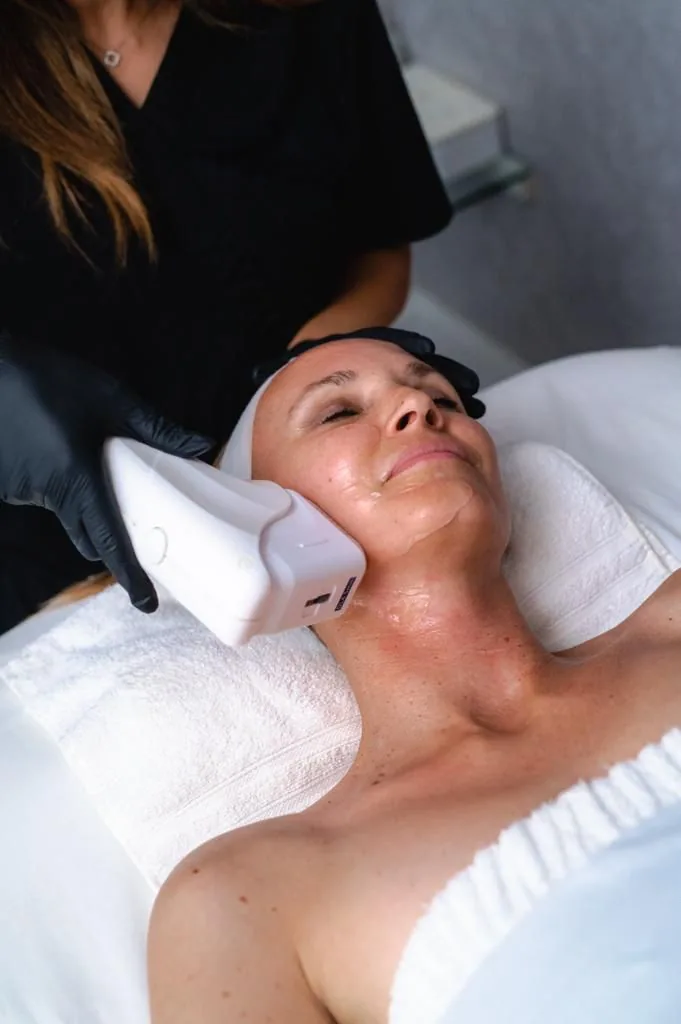
Our 60-minute LED Skin Tightening Facial ($250) begins with the same cleanse and exfoliation, then adds light. We use the Perfectio X, which combines red and infrared LEDs, and the Sapphire X, which emits blue light at 415 nm. Both are FDA-cleared Class II devices. That clearance covers the device itself, not any particular result on your skin.
Red and infrared light are generally used to support a more rested, radiant look. Many clients describe their skin as looking a little brighter for several days after a session. Blue light at 415 nm is aimed at the look of blemishes. That matters for tone in an indirect way. Fewer breakouts may mean fewer new marks forming over the coming months.
Here is the limit. Neither red nor blue LED is a pigment-targeting technology. We do not use it to fade a specific spot, and we do not promise that it will. We use it to support a brighter overall look while regular exfoliation and sun protection do the slower work. For a closer look at how each light is used, see our LED facial page.
The marks a breakout leaves behind tend to fade on their own, though it can take months, and the brown kind often outlasts the pink kind. The two things that slow them down most are picking and sun. Pressing or squeezing a blemish tends to deepen the mark it leaves. Sun exposure may darken a fresh mark and keep it there longer.
A facial series may help the surface along. Gentle exfoliation keeps buildup from settling over the marks, hydration improves how light reflects off the skin, and blue LED sessions may help reduce the look of active blemishes so fewer marks form. A typical starting point is a series of four to six sessions spaced one to two weeks apart, then maintenance every three to five weeks. Results vary, and we adjust the plan after seeing your skin.
If your breakouts are deep, painful or cystic, a dermatologist or physician is the right first step. We are glad to work alongside their advice once the active breakouts are under control. Our acne facial page explains how we approach blemish-prone skin.
Melasma is different from a sun spot. It usually shows up as larger, symmetrical patches across the cheeks, forehead or upper lip, and it is often tied to hormones, heat and light together. It sits deeper in the skin, and it is easily stirred up. Heat, friction and aggressive exfoliation may all make it look darker, which is why we do not consider it a spa concern.
The same caution applies to any deep or stubborn pigmentation, and to a spot that is new, changing in size or color, or irregular in shape. Those are questions for a physician, not a spa. A dermatologist can tell you what the pigment is, how deep it sits, and which prescription or in-office options are designed for it. Once you have that plan, we can support it with gentle surface care if your dermatologist agrees.
This is not us being cautious for the sake of it. A facial that warms or scrubs the wrong kind of pigment may cost you ground you cannot easily win back. We would rather send you to the right door first.
Nothing in this article works without sunscreen. Sun exposure is what darkens sun spots, deepens post-breakout marks and is one of the main things that makes melasma look darker in the first place. Exfoliation also leaves skin a little more sun-sensitive for a few days, so a facial without sun protection may set you back rather than forward.
What we ask of every client is simple. A broad-spectrum sunscreen of SPF 30 or higher on the face, neck and chest every morning, including cloudy days and days spent mostly indoors near windows. Reapply if you are outside for more than a couple of hours. A hat helps more than most people expect. The Fort Worth sun is strong for most of the year, and the drive home from Hulen Mall counts.
If you do only one thing for uneven tone, make it this. Facials may brighten what is there. Sunscreen is what keeps new spots from arriving.
For general dullness and mild unevenness, a typical starting point is an Express Hydrating Facial to see how your skin responds, then a series of four to six LED facials one to two weeks apart, then maintenance every three to five weeks. Our Bronze facial package covers two LED facials and one daily product for $550, which works out to $275 per facial, and it is an easy way to begin a series. Many clients notice a brighter, more even look by the third or fourth session, though results vary and some marks will not change.
Our services are cosmetic services, not medical care. Please talk to your physician before booking if you are pregnant, have a pacemaker, have cold urticaria, have an active skin infection, or have had recent surgery. Note these on your intake form as well. If you have a diagnosed skin condition such as melasma, rosacea, eczema or cystic acne, a dermatologist is the right first step, and we are happy to follow their lead.
Your skincare specialist will look at your skin before anything is booked and tell you honestly which marks may soften and which are better left to a dermatologist. That honest conversation is the most useful part of a first visit.
No. A facial may make a sun spot look less noticeable by brightening the skin around it and softening the contrast, but it does not remove the pigment. For spots you want gone, a dermatologist has prescription and in-office options designed for pigment. Results vary from person to person.
Blue light at 415 nm is aimed at the look of active blemishes, not the marks left afterward. Its value for tone is indirect. Fewer breakouts may mean fewer new marks. The marks themselves tend to fade with time, gentle exfoliation and daily sun protection, though timing varies.
Please see a dermatologist first. Melasma sits deeper in the skin and may look darker after heat, friction or strong exfoliation, so a general facial can work against you. Once your dermatologist has a plan, bring it with you and we will keep any surface care gentle and in line with their advice.
Treatments at Vearitea Wellness Spa are cosmetic and wellness services, not medical care, and are not intended to diagnose, treat, cure or prevent any disease. Results vary from person to person. If you are pregnant, have a pacemaker, cold urticaria, an active skin infection, or have had recent surgery, talk to your physician before booking.
If uneven tone is your main concern, we invite you to book an LED facial and talk through what it may and may not do for your skin.
Keep reading
FaceOur anti-aging facials at Hulen Mall are $250 for RF or LED and $325 for cryotherapy. What each hour includes, how a rotated series is priced, how to compare.
Read the guide
 Face
FacePuffiness is mostly fluid. Dark circles are mostly pigment, thin skin or shadow. What cooling and EMS micro-massage may change, and what they cannot.
Read the guide
FaceRF warmth, red and infrared LED, and cooling compared for fine lines, why many clients rotate, and what facials cannot do for deep wrinkles or lost volume.
Read the guide