
 Wellness
Red Light Bed vs Handheld Panels: Which Is Right for You?
A full-body red light bed, a handheld wand and a panel each do a different job. Here is how coverage, time, convenience and cost compare, and how to use both.
Read the guide
Wellness · 6 min read
Two to three sessions a week for a month, then weekly, is a typical starting point. Why the rhythm matters, when to pause and what the research explores.
Red Light · $360 · 30 min
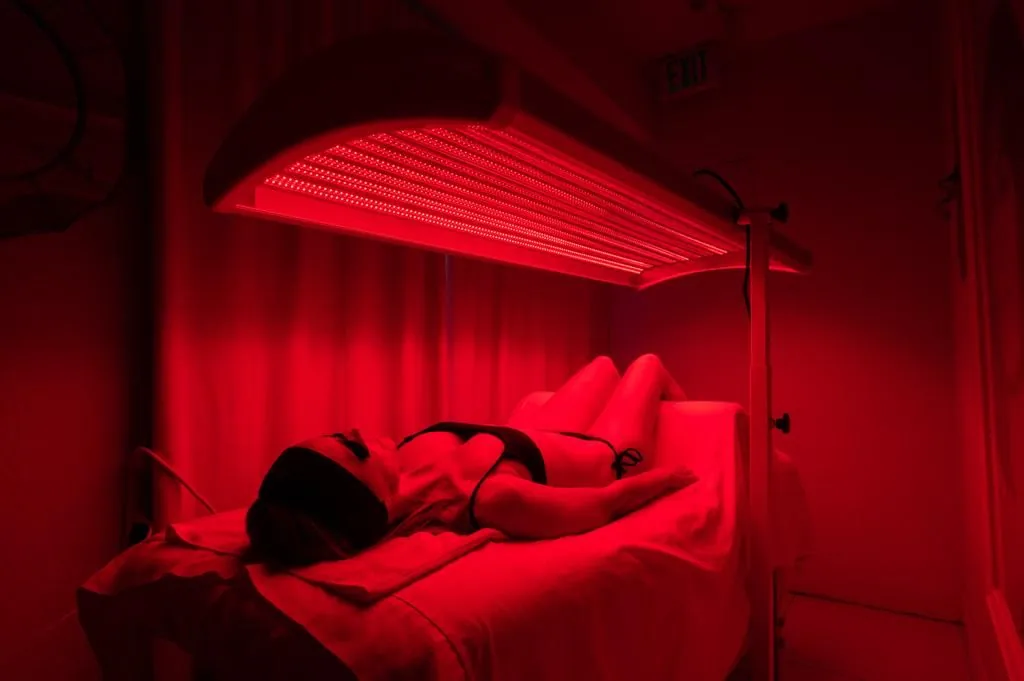
Our red light bed is the Revolutionary Pro, a full-body bed with more than 5,000 red LEDs. A session is 30 minutes and costs $360. The question we hear most after a first visit is how often to come back. A typical starting point is two to three sessions a week for about a month, then one session a week to maintain the look. That is a starting point, not a rule. Results vary, and we adjust the pace with you based on how your skin responds and what your schedule allows.
This guide explains why that rhythm is common, how to think about a first month, when to pause, and what the research actually explores. If you want the session itself described step by step, see our red light therapy page. Our services are cosmetic, not medical care.
Red light does not work like a mask you rinse off. The skin absorbs the light over a session, and whatever cosmetic change many clients notice tends to build gradually across repeated sessions rather than appearing after one. A single session may leave the skin looking slightly brighter for a day or so. A series spaced evenly over several weeks is usually what people mean when they say they noticed a difference.
Spacing matters as much as the count. Three sessions crowded into one week followed by three weeks off is not the same as three sessions a week for a month, even though the total is similar. The skin seems to respond to a steady rhythm. That is why we suggest a cadence first and a total number second.
There is also a practical reason. In our experience, a fixed slot, say Tuesday and Friday after work, is easier to keep than booking one session at a time. A series that drifts rarely shows much.
Weeks one through four: two or three 30-minute sessions a week, with at least a day between them. Rest days matter. We do not recommend two sessions in one day, and a session is 30 minutes. More light in one sitting has not been shown to add anything cosmetic, and it can leave the skin feeling warm or slightly flushed for longer than it needs to.
Keep notes. A photo in the same light on day one and at the end of week four tells you more than memory does. Note how the skin feels after each session too. Mild warmth and a faint pink tone that fades within an hour are common. Anything beyond that, tell us at your next visit.
If after a month you notice little change, that is useful information. Some clients see a modest difference in brightness and the look of texture. Some see very little. Red light is gentle, and gentle also means subtle. We would rather say that plainly than promise more than the light can deliver.
After the first month, a typical next step is one session a week, and many clients settle there. Some prefer one every two weeks and find that holds the look they want. Others, particularly those who use the bed as a calm half hour in a busy week, keep two sessions a week simply because they enjoy them. There is no single right answer. The question to ask is whether the look is holding at the pace you are keeping.
If you stop entirely, any cosmetic change usually fades over the following weeks. That is normal for light-based sessions and is not a sign the series did nothing. It means the look is maintained rather than fixed, which is true of nearly everything we offer.
On cost, at $360 per session, two sessions a week for a month is a meaningful commitment. We would rather you plan for that honestly than start a series you cannot finish. Our pricing page lists every treatment, and Affirm financing is available if spreading the cost helps.
Talk to your physician before booking if you are pregnant, have a pacemaker, have cold urticaria, have an active skin infection or have had recent surgery. These are standard precautions for every light-based session we offer. Please tell us at check-in if any of them apply to you.
Photosensitizing medication is the one that is easy to overlook. Some antibiotics, some prescription acne products, certain diuretics and some herbal supplements can make the skin more reactive to light. If you have started a new prescription since your last visit, mention it at check-in. If you are unsure whether something on your list is photosensitizing, ask the pharmacist who filled it. We would rather reschedule than guess.
Skip a session if you are sunburned, if the skin is irritated from a peel or a retinoid you have just started, or if you have a fever and simply feel unwell. Irritated skin does not need more input. Wait until it has settled, then pick the series back up.
The bed is bright, and we recommend keeping your eyes covered for the full session. Ask us about eye covering when you book so you know what to bring or expect. If you have a known eye condition or have had eye surgery, check with your eye doctor first.
Red light has been studied for decades, mostly under the name photobiomodulation. Some of that research also covers near-infrared wavelengths. Our bed uses red LEDs, so that part of the literature does not map directly onto a session here. The research explores how certain wavelengths interact with cells, and the cosmetic questions most relevant to a spa bed are about the look of skin tone, texture and fine lines. Several small studies report that participants rated their skin as smoother or more even after a series of sessions. Others report little difference.
It helps to know what those studies look like. Many are small. Many use handheld or panel devices with doses that differ from a full-body bed. Session frequency in the research ranges widely, which is partly why we describe two to three sessions a week as a typical starting point rather than a settled schedule. We are honest about that gap.
Research has looked at red light for other, non-cosmetic questions. That work is not what we offer. We provide a cosmetic session on a bed, and we do not make claims about anything beyond how the skin may look and how you may feel afterward. If you have a skin condition you want evaluated, a dermatologist is the right first step.
Many clients find a 30-minute session fits a lunch break or the end of a workday. We are inside Hulen Mall in Fort Worth, with free parking, and the room is quiet enough that a midday session does not feel like an errand. If you are planning two or three sessions a week, pick the days before you book the first one and hold them for a month. A standing slot is the simplest way to keep the rhythm this guide describes.
Since there is typically no downtime, the session does not need to be the last thing you do that day. Some clients come before work, some between errands, some on the way home. What matters for the series is the spacing, not the hour.
For how to prepare, what the session feels like and what to expect afterward, see our guide to the red light bed. This guide is about the rhythm. That one covers the visit itself.
We do not recommend that as a starting point. A day between sessions is a sensible rhythm, and more frequent sessions have not been shown to add anything cosmetic. Two to three sessions a week for a month is a typical starting point, then weekly.
Pick back up where you were. One missed week does not undo a series. If you miss several weeks, treat it as a restart and plan another short run of more frequent sessions before moving back to weekly.
No. If you stop, any cosmetic change usually fades over the following weeks. Some clients keep a weekly slot, some come seasonally, some stop. There is no obligation to continue, and we will tell you plainly if we think the bed is not doing much for you.
Treatments at Vearitea Wellness Spa are cosmetic and wellness services, not medical care, and are not intended to diagnose, treat, cure or prevent any disease. Results vary from person to person. If you are pregnant, have a pacemaker, cold urticaria, an active skin infection, or have had recent surgery, talk to your physician before booking.
If two or three sessions a week sounds like a rhythm you can keep for a month, you are welcome to book a first session and we will help you plan the rest.
Keep reading
WellnessA full-body red light bed, a handheld wand and a panel each do a different job. Here is how coverage, time, convenience and cost compare, and how to use both.
Read the guide
WellnessMany clients pair our red light bed with a facial or the infrared capsule. Here is the order we suggest, how long it takes, what the pair costs and aftercare.
Read the guide
WellnessA 30-minute session on our full-body red light bed is $360. Here is what it feels like, what the research explores, how often people come and who should wait.
Read the guide