
 Face
FaceAcne Facial in Fort Worth: What to Expect at Vearitea
The $125 express cleanse, the $250 session with blue LED at 415 nm, optional cooling, notes on extractions, aftercare, and when a dermatologist comes first.
Read the guide
Face · 6 min read
Jawline breakouts, sensitivity and dryness from actives change how an acne facial should be done. What we adapt, what we avoid, and realistic expectations.
Acne Facial · From $125 · 30–60 min
Breakouts in your thirties or forties tend to look different from the ones you may remember from school. They cluster along the jawline, the chin and the lower cheeks rather than the forehead and nose. They are often fewer in number but deeper, slower to heal, and more likely to leave a mark that lingers for weeks. And they usually arrive on skin that is not oily all over. Many adults describe a combination: a tender bump on the chin, flaking at the corners of the nose, and a tight feeling after cleansing.
That combination is the heart of the problem. The classic acne facial was designed for skin that is oily, resilient and young. It leans on strong exfoliation, long steam, extractions and drying products. On adult skin that is already sensitive or dried out by active ingredients, that approach may leave the skin looking redder and feeling worse. So when a client books an acne facial with us, we start by asking what else is going on, not just where the bumps are.
One note before we go further. Persistent, deep or painful breakouts in adulthood are a reason to see a dermatologist first. A physician can tell you what is driving them and whether a prescription is the right tool. A facial can sit alongside that care. It is not a replacement for it.
The first difference is pace. We spend more of the hour on assessment and on calming the skin, and less on aggressive clearing. Your aesthetician will look at the pattern of breakouts, check for flaking, ask what you use at home and how recently, and ask whether your skin stings when you apply products. Those answers shape the rest of the session.
The second difference is the cleanse. Instead of a foaming, stripping wash, we typically use a gentle, low-foam cleanser and a short, lukewarm steam, or sometimes no steam at all for skin that flushes easily. Exfoliation, if we do it, is light, usually an enzyme or a low-strength acid rather than a scrub or a peel. The goal is to loosen surface buildup without taking the top layer of moisture with it.
Extractions are selective. We may clear a few blackheads or whiteheads that are ready to release. We leave inflamed, tender bumps alone, because pressing on them tends to make them redder and slower to settle. Then the session shifts toward soothing and hydrating, which is where adult skin usually benefits most.
Some things that belong in a classic acne facial simply do not belong on adult skin that is sensitive or dry. On the day of your visit we avoid physical scrubs, high-strength acid peels, alcohol-based toners and anything heavily fragranced. We do not layer a retinoid during the session, and we do not apply strong drying spot treatments across the whole face.
We also avoid stacking actives. If your skin is already handling a retinoid, a benzoyl peroxide wash and an acid toner at home, adding more in the treatment room is likely to tip it into irritation. Our job on the day is to give the skin a break, not another round.
If you use a prescription retinoid, ask your dermatologist whether to pause it for two or three nights before your visit. Their instructions come first. For over-the-counter acids, pausing a few nights beforehand tends to make the session more comfortable and lets us read your skin more accurately. This is a suggestion, not a rule.
Adults who have tried to manage breakouts on their own often arrive with a weakened skin barrier. Months of acids, retinoids and drying washes can leave the outer layer of skin less able to hold water. When that happens the skin looks dull and flaky, feels tight, and may react to products it used to tolerate. Breakouts on top of that look angrier than they would on calm skin. Fort Worth does not help here. Summer adds sweat and sunscreen to the mix, and the dry indoor air of winter pulls moisture out.
Hydration is how we address this. We typically use humectants such as glycerin and hyaluronic acid, which draw water into the skin, and follow with ingredients such as ceramides and squalane that help the skin hold on to it. These are not acne ingredients in the usual sense. They are barrier ingredients, and in an adult acne facial they often matter more than anything aimed at the bump itself.
Clients are sometimes surprised that we often finish with a soothing, creamy mask rather than a clay one. The reason is that well-hydrated skin tends to look calmer and more even, and many clients notice that redness around breakouts looks softer afterward. Oil and water are different things. Adding water to dehydrated skin does not make it oilier.
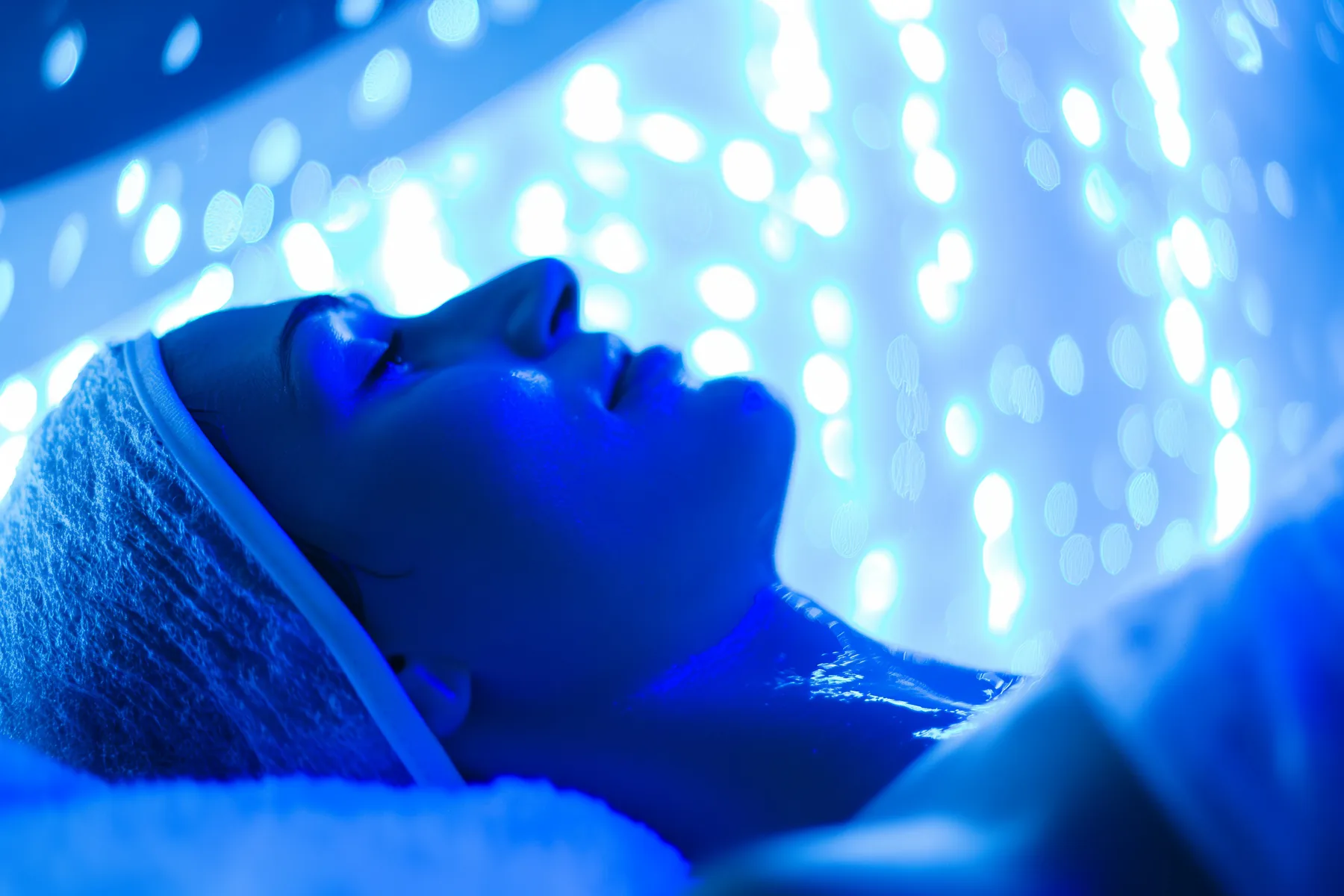
Light can be a useful part of an adult acne facial because it adds nothing to the skin and takes nothing away from it. We use the Sapphire X, which delivers blue light at 415 nm. It is an FDA-cleared Class II device, and the clearance covers the device itself, not a particular result. Blue light at this wavelength is commonly used for blemish-prone skin, and the session feels gently warm rather than hot.
For adult skin we often pair it with red and infrared light from the Perfectio X, which is also an FDA-cleared Class II device with the same scope. Red light is commonly used for the look of redness and uneven tone, which is often the part of adult acne that bothers people most. Both devices are part of our LED facial, which is $250 for 60 minutes. If light makes sense for your skin, we will tell you at booking whether it fits within your session or is better done as a separate LED facial. You can read about how the two colors differ on our LED facial page.
Many clients leave with skin that looks calmer and feels comfortable. There is usually no downtime. Some pinkness after extractions is normal and typically settles within a few hours. We suggest skipping makeup for the rest of the day if you can, using a gentle cleanser that evening, and waiting a night or two before restarting over-the-counter acids. If you use a prescription retinoid, follow your dermatologist's guidance on when to restart it.
Over the following days, many clients notice that flaking eases and that existing breakouts look less red. New breakouts may still appear. A facial does not stop the process that causes them, and we would be misleading you if we said otherwise.
A facial may temporarily reduce the look of congestion and redness, and it may help the skin feel more comfortable. It does not clear adult acne on its own, and a single visit is unlikely to change the pattern. A typical starting point is a session every three to four weeks for a few months, with gentle at-home care in between. Results vary, and we adjust as we see how your skin responds.
If breakouts are deep, scarring or spreading, or if you suspect a condition such as rosacea or cystic acne, a dermatologist or physician is the right first step. Our services are cosmetic services, not medical care. Please talk to your physician before booking if you are pregnant, have a pacemaker, have cold urticaria, have an active skin infection, or have had recent surgery.
If this sounds like the kind of facial you have been looking for, you can read more on our acne facial page, or book a first session at our spa in Hulen Mall. We will look at your skin before anything else and tell you plainly what we think may help.
Some pinkness after extractions is normal and usually settles within a few hours. We do not use strong peels on sensitive adult skin, so a flare after a visit is uncommon. If your skin does react, tell us and we will adjust the next session.
Often yes, but tell us at booking. Ask your dermatologist whether to pause it for two or three nights before your visit. Their instructions come first. On our side, we keep exfoliation light and avoid adding more actives during the session.
Every three to four weeks is a typical starting point. We reassess after two or three visits and adjust the spacing to how your skin is responding. Results vary.
Treatments at Vearitea Wellness Spa are cosmetic and wellness services, not medical care, and are not intended to diagnose, treat, cure or prevent any disease. Results vary from person to person. If you are pregnant, have a pacemaker, cold urticaria, an active skin infection, or have had recent surgery, talk to your physician before booking.
If jawline breakouts on sensitive, dry skin sound familiar, book an acne facial and we will adapt the session to what your skin may need.
Keep reading
FaceThe $125 express cleanse, the $250 session with blue LED at 415 nm, optional cooling, notes on extractions, aftercare, and when a dermatologist comes first.
Read the guide
FaceOccasional breakouts and cystic acne are different problems. Here is how we decide when a facial fits and when we send you to a dermatologist first.
Read the guide
FaceA calm guide to blue 415 nm LED light for blemish-prone skin: what it is commonly used for, session rhythm, pairing with a gentle cleanse, and who should wait.
Read the guide