
 Face
FaceAcne Facial in Fort Worth: What to Expect at Vearitea
The $125 express cleanse, the $250 session with blue LED at 415 nm, optional cooling, notes on extractions, aftercare, and when a dermatologist comes first.
Read the guide
Face · 6 min read
A calm guide to blue 415 nm LED light for blemish-prone skin: what it is commonly used for, session rhythm, pairing with a gentle cleanse, and who should wait.
Acne Facial · From $125 · 30–60 min
Blue light sits at the short end of the visible spectrum. The band used in most cosmetic devices is close to 415 nanometers, which is a deep, clear blue. At that wavelength the light is absorbed almost entirely at the surface of the skin. It does not reach the deeper layers the way red or infrared light does, and it does not warm the tissue. For blemish-prone skin, that surface focus is the point.
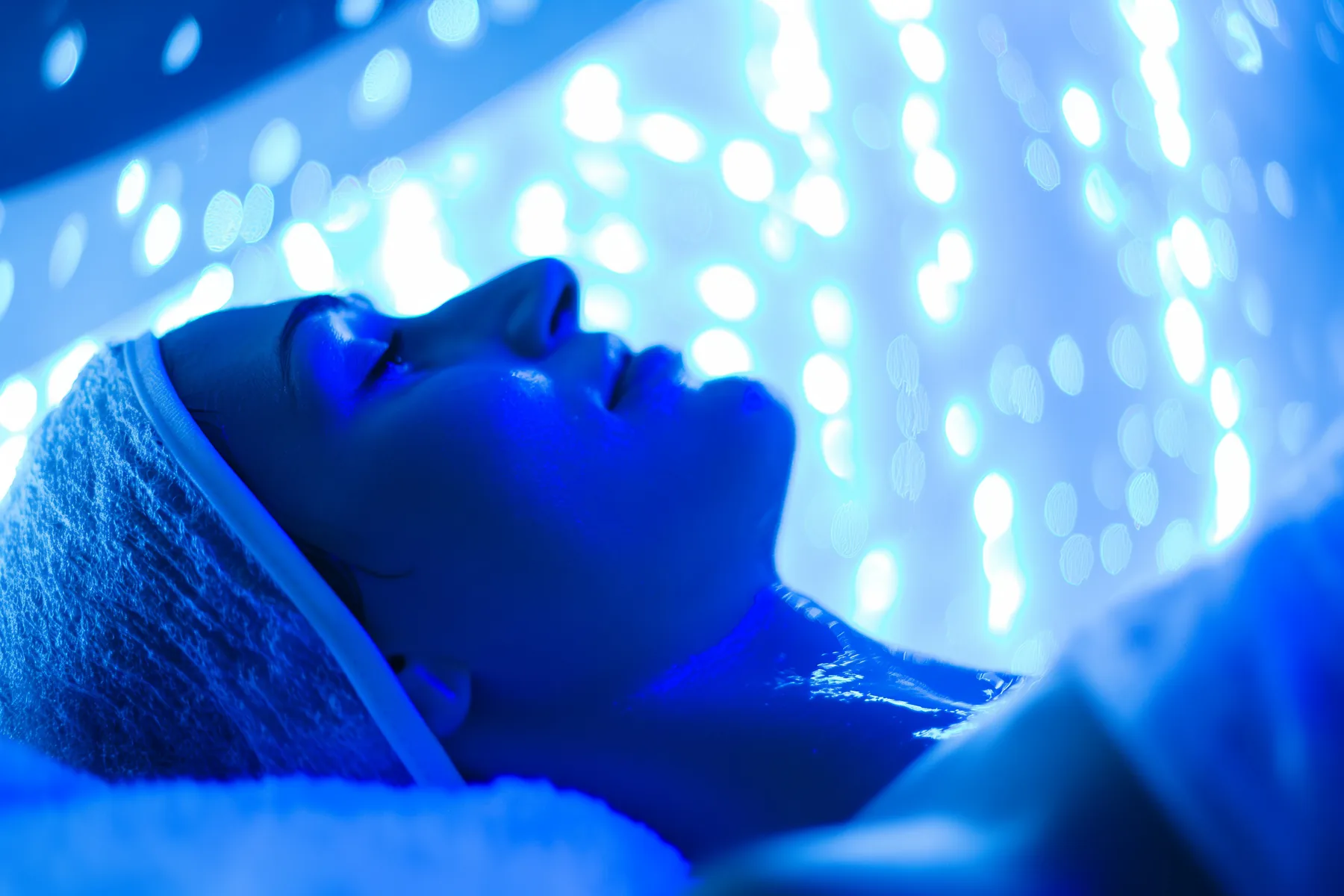
In our spa the blue phase of a facial comes from the Sapphire X, a blue 415 nm LED device. The Sapphire X is an FDA-cleared Class II device. That clearance covers the device itself, not any particular result on your skin. We mention it because the distinction matters. Clearance means the FDA found the device substantially equivalent to a device already on the market. It does not tell you what your skin will do.
The light is bright but gentle. You wear eye protection and the exposure is timed. There are no needles, no acids and no abrasion in the light phase.
The idea behind blue light is specific. The bacteria that live on the surface of blemish-prone skin produce compounds called porphyrins. Porphyrins absorb light strongly at around 415 nm. When they absorb that light, they produce reactive molecules that, in laboratory settings, affect the bacteria around them. This is the mechanism the research explores, and it is why the exact wavelength matters more than the color in a general sense.
In practice, blue light is commonly used in routines for skin that is prone to occasional breakouts, congestion and an oily, uneven surface. It is commonly paired with a gentle cleanse and a calming finish rather than with strong actives. Some people find that their skin looks calmer and clearer over a series of sessions. Results vary, and others notice very little.
What blue light is not commonly used for is deep, painful or cystic breakouts. Those sit below the reach of the light and usually have causes the light cannot touch. If that is your skin, a dermatologist is the right first step, and a facial can come later as a comfortable complement to whatever plan you agree on.
Blue light for blemish-prone skin has been studied for more than two decades. Many small trials report that participants had fewer visible blemishes after a course of sessions, usually one or two sessions a week for several weeks. Some trials compare blue light alone with blue light combined with red light, and a number of those favor the combination.
The honest caveats are familiar ones. The studies tend to be small. They use different devices, different doses and different session schedules, which makes them hard to compare. Follow-up periods are often short, so it is not clear how long any change lasts without upkeep. And blemish-prone skin changes on its own with the seasons, with stress and with hormones, which makes it hard to know how much of any improvement came from the light.
So our summary is careful. There is a plausible mechanism. There is a body of encouraging small studies. There is not yet large, long-term evidence that would let anyone promise a result. We would rather say that plainly than overstate it.
Blue light works at the surface, so what is on the surface matters. A facial for blemish-prone skin typically begins with a thorough but gentle cleanse to lift makeup, sunscreen and excess oil. We avoid harsh scrubs and strong acids before the light phase. Skin that has just been exfoliated aggressively tends to be more reactive, and the goal of the session is to calm, not to provoke.
After the cleanse, the light phase follows. Then the skin is finished with light hydration rather than heavy creams. Blemish-prone skin often does better with less, and a thin, non-greasy layer is usually enough. We will tell you what we used so you can decide whether to keep it in your routine.
If you are curious about how the blue phase fits alongside red and infrared in a full session, see our LED facial page. For the facial built around blemish-prone skin specifically, see our acne facial page.
Blue light is usually planned as a series, not a single visit. The research protocols that report the clearest results tend to use a series of sessions rather than a single exposure, and that is how we plan a series. A typical starting point is a short series, with sessions spaced roughly a week apart, followed by a pause to see how your skin settles.
After that, many clients move to an occasional session as upkeep. How often depends on your skin and on what else you are doing at home. We will not set a number for you before we have seen your skin.
Between sessions, the simplest habits help the most. A gentle cleanser twice a day. A sunscreen you will actually wear. Fresh pillowcases. No picking. None of that is glamorous, and all of it matters more than the light.
Some medications make skin more sensitive to light. Certain antibiotics, oral and topical retinoids, some diuretics and a few herbal supplements fall into that group. If you take anything that carries a sun-sensitivity warning, bring it up when you book, and check with the prescriber before a light session. We would rather reschedule than guess.
If you are pregnant, the cautious choice is to wait. Blue light has not been well studied in pregnancy, and a gentle hydrating facial without the light phase is an easy alternative. If you have a diagnosed skin condition such as rosacea or eczema, or a history of light-triggered reactions, a dermatologist or physician is the right first step before any light-based facial.
Our facials are cosmetic services, not medical care. Please talk to your physician before booking if you are pregnant, have a pacemaker, have cold urticaria, have an active skin infection or have had recent surgery. Light-based facials are not done over open or broken skin.
Blue light reaches the surface. It does not change hormones, diet, stress or the oil glands below the surface, and those are often where blemishes begin. It may temporarily reduce the look of surface blemishes and congestion for many people, and it does not replace a dermatologist's plan for persistent breakouts.
Results also fade without upkeep. The surface of the skin renews itself constantly, and whatever the light did last month does not carry forward on its own. If that sounds like a reason to think carefully before starting, we agree. It should be a considered choice, and we are glad to talk it through at our Hulen Mall spa in Fort Worth before you book anything.
Blue light is aimed at the bacteria involved in blemishes, not at the oxidized oil that makes a blackhead look dark. Results vary, and some clients see calmer, less congested skin over a series, while blackheads themselves usually respond better to a gentle cleanse and regular care.
You can. The skin is usually calm and a little bright right after. Many clients prefer to leave it bare for the rest of the day, but there is no rule, and a light, non-greasy product is fine if you have somewhere to be.
Blue 415 nm light does not heat the skin. Some research on visible light suggests that blue-violet light may contribute to the look of darker marks in deeper skin tones, so if you have a history of marks that linger after breakouts, tell us when you book and we may suggest a shorter exposure or a different facial. If melasma is a concern, a dermatologist is the right first step.
Treatments at Vearitea Wellness Spa are cosmetic and wellness services, not medical care, and are not intended to diagnose, treat, cure or prevent any disease. Results vary from person to person. If you are pregnant, have a pacemaker, cold urticaria, an active skin infection, or have had recent surgery, talk to your physician before booking.
If blemish-prone skin is your concern, you are welcome to book a facial with us; results vary, and we will be honest about what the light can and cannot do for you.
Keep reading
FaceThe $125 express cleanse, the $250 session with blue LED at 415 nm, optional cooling, notes on extractions, aftercare, and when a dermatologist comes first.
Read the guide
FaceOccasional breakouts and cystic acne are different problems. Here is how we decide when a facial fits and when we send you to a dermatologist first.
Read the guide
FaceJawline breakouts, sensitivity and dryness from actives change how an acne facial should be done. What we adapt, what we avoid, and realistic expectations.
Read the guide